
Cyber Monday should be one of the most profitable days of the year for ecommerce merchants. Instead, many Shopify store owners spent hours locked out of their admin panels, watching orders pile up whilst their teams couldn’t access fulfilment systems or manage customer queries.
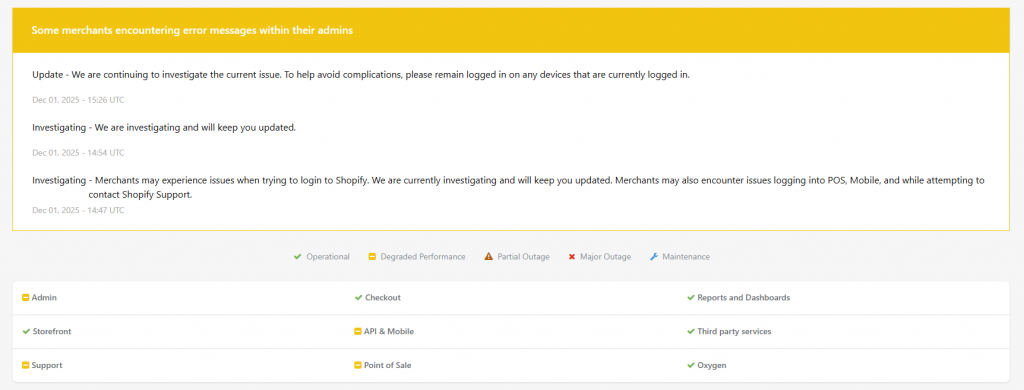
During peak trading, significant portions of Shopify’s infrastructure were either offline or severely degraded. As an experienced ecommerce manager managing multiple Shopify stores, I saw the impact first-hand. My ecommerce clients couldn’t access their dashboards, integrations failed, and fulfilment ground to a halt, right when they needed the platform most.
The most frustrating part? Shopify’s near-total silence whilst merchants scrambled.
Shopify’s Communication Breakdown
What made this outage particularly damaging wasn’t just the timing. It was how Shopify handled it. Their main @Shopify account on X.com said nothing, presumably to protect brand perception during their biggest trading period.
The only acknowledgement came from @ShopifySupport:
“We had a system degradation that has now been mitigated. We kept checkout and storefronts online, but access to admin interfaces was temporarily unavailable for some merchants. This briefly extended to POS but was quickly resolved.”
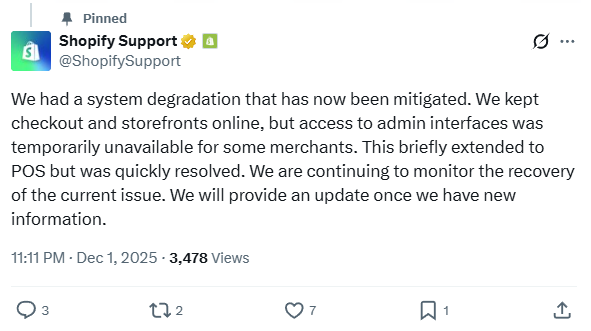
As of writing, that tweet has barely 3,000 views, 11 hours later. That’s not transparency really is it? It’s damage limitation.
For merchants running businesses that depend entirely on Shopify, learning about a major outage through a low-visibility support account isn’t good enough. When your platform goes down during the busiest trading day of the year, merchants deserve clear communication, not corporate spin buried where most won’t see it.
What Actually Is “System Degradation” Anyway?
Shopify’s update used the phrase “system degradation” but never explained what that actually meant. That leaves us wondering:
- Infrastructure failure?
- Database issues?
- Unexpected load from Cyber Monday traffic?
- Configuration error?
- Something else entirely?
We don’t know and that’s the problem. When platforms leave information gaps, merchants fill them with worst-case scenarios. Because of the timing around Cyber Monday, the press have led with “Cyber” related headlines. “Cyber Monday” and “cyber security” aren’t far apart in people’s minds.
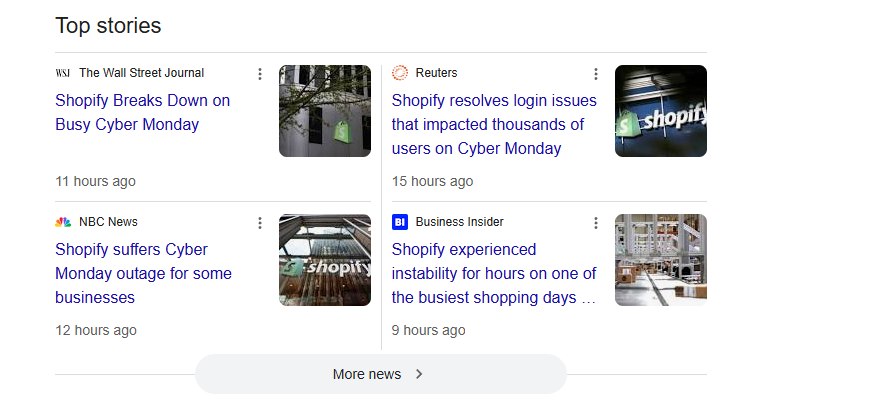
A platform of Shopify’s scale should explain what happened in plain language, what caused it, and what they’ve done to prevent it happening again. Not for PR reasons, but because merchants deserve clarity when their livelihoods depend on it.
Yes, the front-end of the websites were up so checkouts could still happen but it’s the staff behind the scenes trying to meet delivery deadlines and having customers ringing up chasing orders that weren’t delivered that I feel sorry for.
Every Platform Has Bad Days – But Communication Makes the Difference
To be fair, this isn’t unique to Shopify. I’ve seen this happen time and time again across platforms.
- Magento stores crash when servers buckle under traffic. I’ve experienced this numerous times with high loads or integration conflicts. Even log files filling up in the background have toppled sites.
- WordPress/WooCommerce sites regularly fail due to hosting bottlenecks or plugin conflicts (especially auto updates happening in the background)
- BigCommerce, Salesforce Commerce Cloud, and others all experience outages
- Even Amazon, Cloudflare, and Google Cloud have suffered system-wide failures. Both Amazon Web Services and Cloudflare experienced this on a large scale in the past couple of months making headline news
No platform is immune. High scale, heavy traffic, and complex distributed systems will always carry some risk.
However, how you manage the communication sets you apart from the competition in these cases.
Shopify excels in many areas including speed, ease of use, integrations, global infrastructure. But yesterday exposed a significant weakness including proactive, transparent communication during critical incidents.
Merchants don’t expect perfection but I think most expect honesty.
The Christmas Question Mark
Cyber Monday is massive, butit’s nothing compared to the run-up to Christmas. Many merchants will now be asking:
- Could this happen again?
- Was it caused by traffic volume?
- Has the underlying issue been fixed?
- Can we trust the platform during our busiest period?
- Without a proper debrief, it’s hard to feel confident. And if you’re a partner or consultant like me, managing multiple stores, you’re the one clients turn to for answers you don’t have.
A clear, honest incident report would go a long way towards restoring confidence before the Christmas rush.
What Shopify Needs to Do Next
To rebuild trust after a high-profile outage, Shopify should:
- Publish a proper incident report
Send it to agency / partners at the very least if not the clients also. No marketing spin but a genuine breakdown of what failed, why it failed, and how it’s been fixed. - Communicate from main channels
Hiding outages on secondary support profiles makes merchants feel like problems are being swept under the rug. - Reassure merchants heading into peak season
A statement outlining system improvements, capacity monitoring, or resolved vulnerabilities would settle nerves considerably. - Treat transparency as a feature
Because in a competitive market where merchants have choices, it genuinely is one.
My Experience as a Shopify Partner
I’ve worked with Shopify for years. I build stores on it, manage them, market them. I rely on the platform because most of the time, it’s exceptional. But even the best platforms have flaws, and yesterday exposed a significant one.
My clients didn’t just experience downtime, they experienced confusion and anxiety because they were left without information during the biggest trading day of the year.
Shopify is brilliant at many things, but communication is part of reliability. When merchants understand what’s happening, they stay calm. When they’re left in the dark, they panic.
Yesterday (and even today – it’s not too late) we needed better communication.
A Final Thought From Me
Ecommerce is unpredictable from an infrastructure standpoint. Outages happen. Platforms wobble under pressure. It doesn’t matter whether you’re on Shopify, Magento, BigCommerce, or WooCommerce. We all know that no system is invincible.
What matters is how platforms support the people who depend on them.
Shopify now has an opportunity to strengthen merchant relationships by being open about what caused this incident and what steps they’ve taken to ensure it doesn’t happen again. A clear follow-up would calm nerves ahead of Christmas and reinforce the trust merchants place in the platform.
As for me, I’ll continue helping clients build resilient ecommerce operations, because even when the unexpected happens, the right systems and strategies mean you’re never powerless.
Need support preparing for peak trading periods or optimising your Shopify setup? Get in touch.