
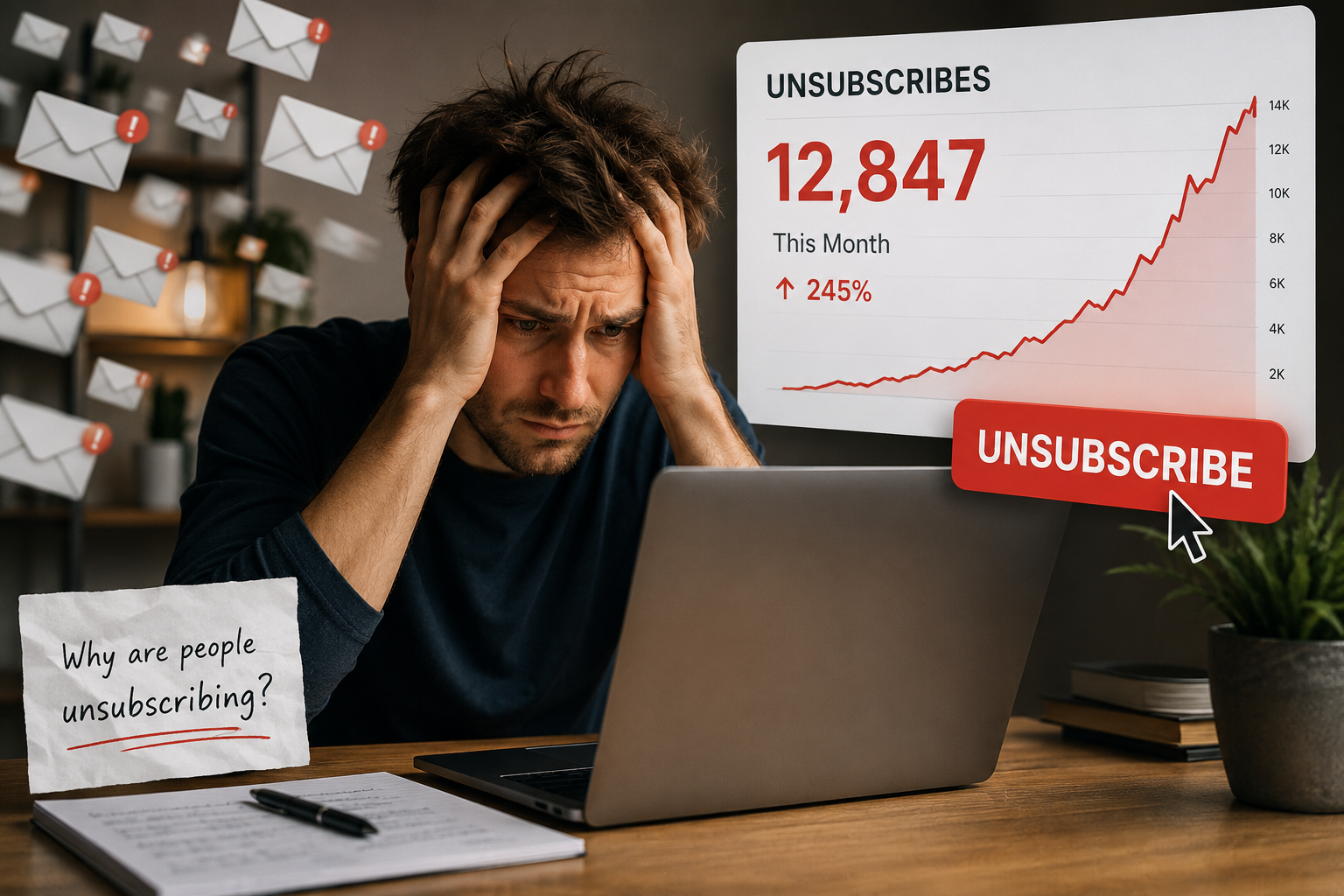
One of the most frustrating aspects of email marketing in ecommerce is seeing people unsubscribing from your mailing list. When you open up Klaviyo or whatever ESP you use, and see the unsubscribe figure getting larger each passing month, you may wonder what you can do to prevent people from unsubscribing from your email list.
As part of my work as an ecommerce consultant, I’ve worked directly managing email marketing campaigns for online stores, as well as alongside specialist email marketers at agency level. After working on ecommerce email strategy, these are the most common reasons that people unsubscribe from online store emails. Some of them may not appear on other lists or cited by AI because they are personal findings, not just regurgitated and outdated advice.
A small caveat – no matter what you do, you will get unsubscribes. It’s part of the job. The trick is to make sure the number is at a low level and not growing consistently.
1. People Didn’t Want To Receive Your Marketing Emails In The First Place
Some people will sign up to accept emails at the checkout stage of your conversion funnel, not because they want to receive future email marketing emails, but rather to ensure they get the initial order updates. Once their order has been dispatched and they received it, they’re no longer interested in receiving further emails. Ultimately they’ll unsubscribe, and honestly that’s fine.
No point wasting account “sends” on people who aren’t opening / clicking.
2. Too Many Emails
A pretty obvious one but worth mentioning. In ecommerce, a safe number of marketing emails to send, seems to be between 1 and 3 emails a week. This varies by industry, the products you sell, and your customers.
If you sell the same range of products across the season, and struggle to differentiate the content of your emails over the course of a month, it may well be that you don’t send as many. If you constantly receive fresh drops of products (think fashion, especially multi-brand retailers), it may make sense to send more.
A lot of brands make the mistake of seeing a short-term revenue spike from increased sends and assume they should keep going. Then three months later, their unsubscribe rate has doubled, engagement has dropped, and Gmail starts quietly pushing more of their emails into Promotions or Spam.
Highly engaged customers can usually tolerate a much higher send frequency than inactive subscribers. That’s why email marketers hammer home the importance of segmentation.
3. Your Emails Are Boring
Stop sending the same email template. The same boring sales emails.
- “20% Off Ends Tonight.”
- “Last Chance.”
- “Still Time To Save.”
Customers become blind to it after a while. Some ecommerce stores fall into a cycle where every single email feels transactional. Sale after sale after sale. The problem is that if every email screams urgency, eventually none of them feel urgent anymore.
Try mixing in:
- behind the scenes content
- founder stories
- product education
- styling inspiration
- customer spotlights
- buying guides
- “new arrivals” emails that don’t immediately push discounts
Your customers signed up because they liked your brand or products. Not because they wanted to be shouted at three times a week.
4. Customers Don’t Like Being Sold To Constantly
There is a difference between marketing and relentless selling.
Some ecommerce brands become obsessed with immediate revenue attribution. Every email has to generate sales instantly. The result is that customers start feeling like walking wallets rather than actual people that you’re communicating with.
Ironically, the brands that often perform best over the long-term are the ones that occasionally send emails with no hard sell at all.
Sometimes the best emails are:
- useful
- entertaining
- educational
- relatable
If every subject line is trying to create panic or urgency, customers eventually disengage. The goal isn’t just to get the click today. It’s to keep the customer interested in your brand six months from now.
5. Your Customer Changed Taste
Depending on your niche, let’s take clothing for example, customers might have changed their style. Where they were once dressing in monotone colours, they may be going through a change and exploring their colourful side. Where they once loved your skinny jeans, they now want baggier fitting clothing.
The same can be said about sizing. Your customer who once wanted plus-sized clothing that your store prides itself, has now lost weight and now wants something to suit their sizing.
Sometimes unsubscribes have absolutely nothing to do with your email strategy. People’s lifestyles, interests and priorities simply change over time.
6. The Customer Is Already Receiving Far Too Many Emails
It’s not you, it’s them. That is how break-ups sometimes happen and it’s not really your fault, although you probably contributed to the problem.
According to recent data from Readless, the average customer receives 117-121 emails per day. That’s a mix between personal, work and marketing emails. It’s too much. You’ll have experienced it yourself when you open up your inbox on a morning and you’re flooded with another load of emails that you flick through but don’t really read.
You’re not just competing against other brands in your niche anymore. You’re competing against every newsletter, every Slack notification, every Teams message, every LinkedIn alert and every ecommerce brand they’ve ever bought from.
One way to combat this is to send some form of reactivation campaign to people who aren’t actively clicking your campaigns. Try and get them engaged in a sea of emails by enticing them with an offer in then subject line.
7. Your Emails Aren’t Personalised To The Individual
Be it the wording or the products, if your emails aren’t personalised to them, they can get lost in a sea of inbox clutter.
And no, personalisation isn’t just throwing “Hi Mark” into the subject line anymore. Customers are used to that now.
Good ecommerce personalisation is behavioural.
- products based on browsing history
- category interests
- previous purchases
- sizing preferences
- favourite brands
- location
The closer your emails feel to the customer’s actual interests, the less they feel like mass marketing.
Studies from Optimfai continue to show that personalised subject lines can improve open rates significantly. Some datasets report increases of over 20%.
8. You Are Emailing People Who Never Opted In For Marketing
If you are doing this, stop doing it now. First of all, if your customer never opted in for email marketing and you are emailing them, with every email they receive, it’ll at the very least provoke an annoyance within them. They will ultimately unsubscribe.
Now the major point. It is illegal. The ICO can impose massive fines of £17.5 million or 4% of annual worldwide turnover, whichever is higher. Did that stop you in your tracks? I hope so. They take it seriously.
Go and check your segments and your mailing list, and ensure that your customer specifically ticked the box to opt into email marketing. If you can’t prove consent, you potentially have a serious compliance issue waiting to happen.
9. Your Discount Emails Have Trained Customers To Ignore Full Price Emails
If every email contains a discount code, customers eventually stop valuing your emails unless there’s money off involved. Worse still, some customers become conditioned to wait for the next promotion instead of buying at full price.
This becomes especially damaging for fashion and lifestyle brands trying to build perceived value around their products.
Discounts should support your email strategy, not become the entire strategy.
10. Your Brand Promise Doesn’t Match the Reality You Are Creating
Sometimes people unsubscribe because the experience after purchase didn’t live up to expectations.
- Maybe the delivery took too long.
- Maybe the product quality disappointed them.
- Maybe customer service was poor.
- Maybe returns were difficult.
Email marketing can drive the first order, but it can’t fix a poor customer experience.
In many cases, unsubscribes are actually a symptom of wider ecommerce problems elsewhere in the business.
My Final Thoughts
Unsubscribes aren’t always a bad thing. In fact, a healthy email list should naturally clean itself over time.
The real problem isn’t unsubscribes themselves. It’s when disengagement becomes a pattern.
If your unsubscribe rate is growing consistently, it’s usually a sign that something within your email strategy, customer experience or targeting needs attention.
The best ecommerce email marketing doesn’t just chase short-term revenue. It builds familiarity, trust and long-term customer retention.
If your ecommerce store is seeing rising unsubscribe rates, declining email engagement, or struggling to retain customers long-term, the issue is often deeper than just the emails themselves.
Customer retention is connected to everything from acquisition quality and SEO intent, through to user experience, product positioning and post-purchase communication.
Through my ecommerce consultancy services, I help online stores identify growth bottlenecks and build strategies designed for long-term customer value rather than short-term spikes.
If you’d like help improving your ecommerce retention strategy, feel free to get in touch.