

If an affiliate’s sales suddenly jump after months of nothing, the traffic all lands on your homepage, and the conversion rate is high on barely any clicks, you are likely paying commission for sales you already earned. That isn’t a good affiliate. It’s almost like someone standing at the finish line and taking credit for a race they never actually participated in.
I caught another one doing exactly this when conducting an ecommerce consultancy session on a client’s programme recently. They were dormant for months, then a run of confirmed sales sprung up out of nowhere. This post walks through how I traced it, the checks anyone can run, and what to do once you’ve found it. This actual method contains numerous checks that work on any affiliate network.
What Does Affiliate Fraud Actually Look Like?
Genuine affiliates almost have a signature that you can look for. A blogger who reviewed your jacket sends readers to that jacket, with anchor text about that jacket, and the traffic converts at a normal rate for editorial. A CSS affiliate who has been running Google Shopping ads and traffic lands on the product page. Discount code affiliates will send people to your homepage most of the time. Cashback sites usually land on the homepage unless you have specifically set up different landing pages in conjunction with them.
Affiliate fraud has a different signature, and once you’ve seen it once or twice, you can smell it a mile off. It’ll make you suspicious every time you see the same pattern.
The particular pattern that gave this one away:
- A publisher that sold almost nothing for months, then a sharp, sustained spike of sales.
- Every click landing on the homepage, never a product or category page.
- A high conversion rate on very little traffic.
- A gap of a few days between the recorded click and the order.
- It was traffic from an affiliate subnetwork – this is often where they lie to mask their true identity
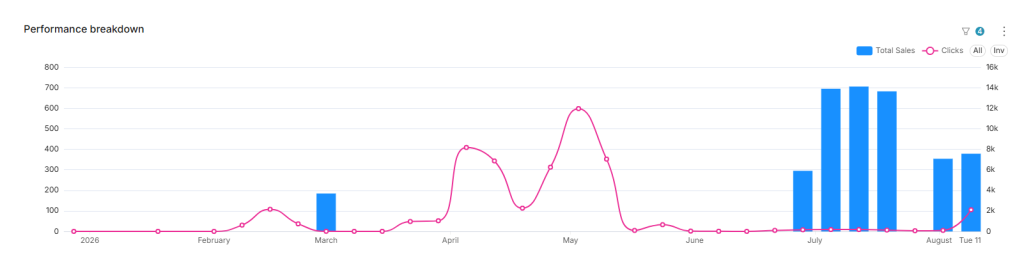
That combination, sparse traffic converting unusually well, is the giveaway. A real content site sends a lot of curious readers, most of whom don’t buy, so its conversion rate sits at a believable level. A publisher that barely sends anyone yet converts most of them isn’t driving demand at all. It’s attaching itself to demand you created and claiming the credit.
Why Would An Affiliate Fake Sales?
Because it pays good money, and because your best customers are the easiest to steal. Someone who has already decided to buy from you, typed your brand into Google, and is one click from checkout is worth more to a fraudster than a cold reader, because that sale is going to happen regardless. All they have to do is get their tracking cookie onto that customer before the order lands.
Three methods show up again and again:
- Brand bidding. Running paid search ads on your brand name, or your brand name plus “discount code”, to intercept people already looking for you.
- Cookie stuffing. Dropping an affiliate cookie on a user through a hidden redirect, iframe or browser extension, with no real click and no content read.
- Coupon and cashback arbitrage. A thin site promising a discount code that exists only to sit between the customer and your checkout and grab the last click.
None of these bring you a customer you didn’t already have so it’s a waste of commission on your part, and you detract from the actual channel performance where it originated. They just insert a middleman into a sale that was already yours.
Top Tip: If you run sale periods such as a Summer Sale or Winter Sale, this is when this kind of activity really ramps up in volume so be extra vigilant.
How Do You Investigate A Suspicious Affiliate?
There’s usually four steps. You can run all of them yourself with GA4 and a browser, and they move you from “this looks off” to “here’s the proof”.
- Look at where the traffic lands
Pull the affiliate’s transactions and check the landing pages. Product-page landings with sensible referrers look like real editorial. Homepage-only landings, every single time, do not. A real content affiliate sends people to what they wrote about, not to your front door. - Cross-check your analytics against the network’s numbers
Go into GA4, filter to the affiliate campaign, and compare the sessions there against the sales the network is reporting. If the network claims a run of orders but GA4 shows barely any genuine sessions from that source, the sales are being attributed without a real visit. One word of caution: GA4 usually can’t show you the page the click came from, because the referrer is stripped through the redirect. It confirms the traffic exists, not where it started. For that, you trace it yourself. - Pressure-test the source they give you
When I asked the network where the traffic came from, they named a single blog post on a lifestyle site. So I checked it. The site had no backlinks, almost no social following, and the article read like it was written to fill space. Doing a “site: search” in Google showed the post wasn’t even indexed. A page nobody links to, nobody follows, and Google hasn’t indexed cannot be sending you a steady stream of buyers. If a “source” can’t physically produce the traffic being claimed, it isn’t the source. Check the Wayback Machine too: a post that only appears the week you start asking questions is an obvious attempt to deceive. - Trace the real source
This is the part most people skip. I searched Google for the brand name with “discount code”, the way a bargain-hunting customer would. Up came a paid ad for a third-party discount-code page. I clicked the links on it, and every one redirected through the same affiliate’s tracking code before landing on the client’s homepage. The URL even carried Google Ads click parameters, so I could see it was a live paid ad. There was the whole scheme in one click: pay for an ad on the brand’s own name, funnel the customer through an affiliate link, collect commission on a sale the brand had already won.
What Affiliate Rule Violations Should You Look For?
Most of what I’ve described is already banned. Read your network’s publisher terms and you’ll usually find explicit prohibitions on unauthorised PPC or “TM+” bidding (ads on your trademark), on incentivised traffic, and on cookie hijacking, with the network reserving the right to reverse commission earned through any of it. The rules exist but they’re just not enforced unless someone flags a specific case with evidence. That someone is you. It has to be you because in my experience, some account managers at the networks themselves often can’t see this happening as they don’t look deep enough or understand it.
When you audit a programme, the violations worth hunting for:
- Ads on your brand terms you never authorised.
- Publishers landing all their traffic on the homepage.
- Sudden spikes from previously dormant accounts.
- Thin coupon or cashback sites with no real audience.
- A wide gap between clicks and conversions with no editorial content to explain it.
What Do You Do Once You’ve Caught Them?
Act on it before you pay any commissions, not after. Most networks hold commission for a recall or validation period before it’s locked in. While a transaction is still unpaid and inside that window, you can reject it. Fighting to claw money back after it’s been paid out is far harder, so speed matters.
The order I’d work in:
- Reject the disputed transactions while they’re still unpaid.
- Escalate to the network, not the publisher. Asking the affiliate to investigate themselves gets you a delay and a flimsy answer. The network has a compliance team and can suspend the account and look at that publisher’s activity across every brand they work with.
- Suspend the campaign for that publisher so nothing more accrues while it’s looked at.
- Document everything: screenshots of the ad, the redirect chain, the tracking parameters, your GA4 figures. Evidence is what turns “I think” into “here’s proof”.
- Tighten the programme. Shorter cookie windows, a clear no-brand-bidding clause, manual approval for new publishers, and a monthly look at where affiliate traffic actually lands.
An affiliate programme can be one of your better channels when it’s watched properly. The money you lose to a single stuffed cookie or a brand-bidding ad is small on any one order. Left unchecked across a busy quarter, it adds up to a channel that looks like it’s working while it quietly bills you for sales you already made.
Frequently asked questions
Can an affiliate really claim sales they didn’t drive?
Yes. If a customer has an affiliate’s tracking cookie on their device when they buy, most programmes will credit that affiliate, whether or not they did anything to earn it. That loophole is what cookie stuffing and brand bidding both exploit.
How do I know if an affiliate is bidding on my brand name?
Search Google for your brand, and your brand plus “discount code” or “voucher”, ideally in an incognito window. If a third-party page appears as a paid ad and its links redirect through an affiliate tracking URL to your site, someone is bidding on your name to skim commission. Check the URL for Google Ads parameters like gclid to confirm it’s a paid click.
What is cookie stuffing?
It’s when an affiliate drops their tracking cookie onto your device without you clicking a real link, using a hidden redirect, iframe or browser extension. If you later buy from that merchant, the affiliate collects commission for a sale they had no part in.
Can I refuse to pay affiliate commissions I believe are fraudulent?
Usually yes, if you act while the commission is still unpaid and inside the network’s recall or validation window. Reject the transactions, raise it with the network with your evidence, and suspend the publisher. Once commission is validated and paid, recovering it is much harder.
Is it still worth running an affiliate programme?
Yes, when it’s managed. A clean programme with quality content and cashback partners can pull real weight. The problem isn’t affiliates, it’s unmonitored ones. Check where traffic lands, watch for brand bidding, and audit new publishers before they earn.
Think an affiliate is skimming your sales?
I audit affiliate programmes and the rest of your channels to find where the money is actually going, and where it’s leaking. If your affiliate numbers suddenly look too good to be true, they usually are.
15+ years in ecommerce. Consulting in the ecommerce industry to help you grow your store.