
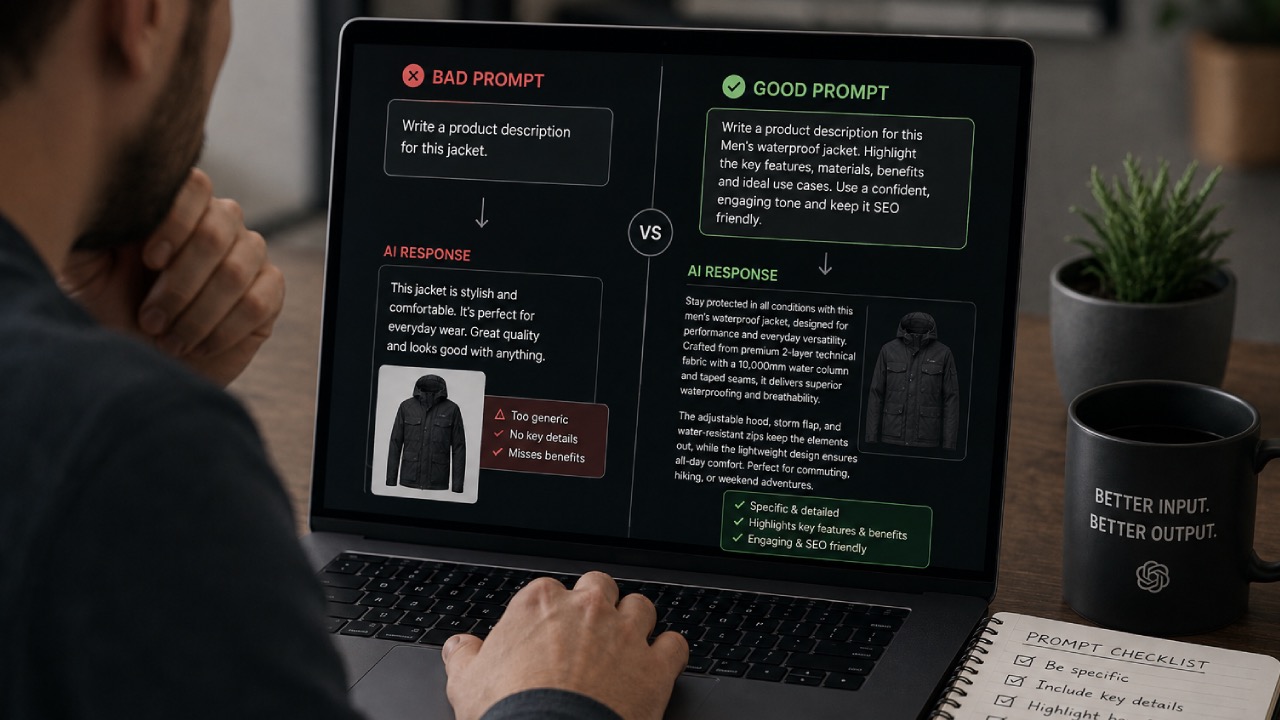
In my recent experience, most ecommerce store owners who try to use AI for product descriptions come away either disappointed or end up with a description that is largely the same as their competitors that did the same. The tone of the copy is quite flat or generic and you can tell that it was never written by someone who actually held or used the product. AI or a particular LLM largely gets the blame for this. However in my view, it’s often the prompt that is the problem from the very beginning.
Quite simply, a bad prompt will result in bad copy. This stands for both product descriptions and written copy like blog posts. I don’t think that’s a flaw in the tool, but rather, that’s just how it works. Let me explain.
Unless you specifically tell it from the outset, AI doesn’t know your product, your customer, your brand voice, or where the description is actually going to live. If you don’t specify this information up-front, it will guess or make assumptions based on previous chat history. This is where you get your bog standard boilerplate sounding descriptions such as “premium quality” and “elevate your style”, essentially, descriptions that you could swap between any two products without anyone ever noticing.
This post is specifically about description, which is one of four principles I use when working with AI (alongside delegation, discernment and diligence). I learnt these when completing my Anthropic certification for AI Fluency. Getting your description right is where most people fall flat in this scenario, although it’s where the biggest gains can be made. I’ll show you real before-and-after examples using actual products, so you can see exactly what changes and why it matters.
What A Bad Prompt Actually Looks Like
Here are two prompts I see regularly, or iterations of them:
- “Write a description for a pair of Adidas Samba trainers that are black and white.”
- “I need a product description for a new brand of coffee that I’ve made.”
Both of these will produce something tangible. ChatGPT or Claude (or your LLM of choice) won’t refuse to write it for you. They’ll write you a description that on the surface looks good, reads ok, then hands it back as if the job’s done. Some models will ask a follow-up question or two depending on what model you’re using, but even then they’re working with barely enough to go on. You’ll get something usable, there’s no doubt in that, but if you want it to persuade your customer and give them everything they need, you’ll spend more time editing it into something that fits your store than it would’ve taken to write it yourself – or you copy and paste it straight from the LLM.
The problem isn’t the prompt length. It’s 100% down to the information that you put into it initially, or the lack of it to be precise. Using a bad prompt leaves out almost everything the AI actually needs to give you what you expected.
Why AI Struggles Without The Right Information
Let’s think of it like briefing a freelance copywriter you’ve never met. You would likely email them something like “write a description for black and white Adidas Sambas,” they’d come back with a list of questions to ensure they fulfilled the brief and didn’t have to rewrite it.
- Who’s the customer? Target age? Target Gender?
- Where does this description go?
- How long should it be?
- What’s the tone of your store?
- Should it have bullet points?
- Should it have headers?
AI doesn’t always ask those questions, and when it does, it doesn’t always ask the right ones or enough of them. You need to front-load the brief with as much of this as possible.
There are five things a good product description needs to do its job properly:
- Tell the AI exactly what the product is and where to find more about it (the same product on the official brand retailer website for example)
- Define who it’s being written for (age, mindset, what they care about)
- Specify the length and format (words, bullet points, subheadings or not)
- Set the tone and voice
- Tell it where the description will be used and how it should end
If you leave out any of those, you’re leaving it to chance. Sometimes you might get lucky but more than often you get something you’d be embarrassed to publish, doesn’t resonate with the target audience or is factually inaccurate.
This is closely related to how AI SEO mistakes happen in ecommerce too, with good tools badly instructed, that produce content which looks fine on the surface but doesn’t serve the store. The prompt is where it goes wrong.
Example One: Nike Air Max 90 (streetwear, younger audience)
Let’s take a product that sits in the streetwear and trainer culture space. The Air Max 90 has decades of heritage behind it, and if you sell it, you’re talking to a customer who knows their trainers / sneakers (even that distinction between whether your customer would search for trainers or sneakers is relevant). A generic description won’t cut through.
The bad prompt:
“Write me a product description for a Nike Air Max 90 in black and white.”
You’ll get something like:
“The Nike Air Max 90 is a classic trainer featuring a comfortable fit and iconic Air cushioning. Available in black and white, this versatile shoe is perfect for everyday wear.”
It’s not wrong. It’s just useless from a conversion and SEO point of view. You could replace “Nike Air Max 90” with almost any trainer and that description would still technically work. There’s no reason for someone to buy it over any other option on the page.
You’re leaving it up to the AI to presume:
- Gender it’s aimed at
- Age range (is it kids, or adults)
- What the materials are (is it leather with suede overlay panels or completely leather?)
The better prompt:
“I need you to write a product description for my Shopify store, which sells designer and streetwear trainers. The product is a Nike Air Max 90 in black and white. The colourway is black upper with white midsole and the iconic visible Air unit in the heel. You can find the product at [URL]. Do not copy that description; it must be unique. Write it for men aged 18 to 30 who are into trainer culture and streetwear. They know what the Air Max 90 is, so don’t over-explain it. Speak to them like they already get it. The tone should be confident, cool, and direct. No corporate language. The description should be around 150 to 200 words. After the main copy, add a bullet point list under the subheading ‘Key Details’ with specs such as colourway, sole unit, upper material and fit notes. End with the anchor text ‘Shop all Nike Air Max’ and I’ll link it to the Nike collection page. Write in British English with no em-dashes. Keep the word trainers, instead of sneakers.”
That prompt takes about 90 seconds to write, yet the output it produces is a different category of content entirely. The AI knows the customer it’s writing it for, the tone, the format, the length and where the description is going. There’s nothing left for it to make assumptions about which gives you a much more powerful end result.
Example Two: Belstaff Roadmaster Jacket (premium, mature audience)
Now a different product, different customer, different everything. The Belstaff Roadmaster is a waxed cotton jacket with serious heritage. The person buying it isn’t 21 and scrolling TikTok. They’re probably in their late 30s or older, they care about quality and provenance, and they’re spending serious money.
The bad prompt:
“Write a product description for a Belstaff Roadmaster jacket in black.”
You’ll likely get heritage mentioned. Maybe motorcycles gets a mention. Probably “iconic” (one of the most overused words in fashion copy). The description will be fine, in a completely generic, forgettable way. But it’s not necessarily targeting the right people with any kind of persuasive copy.
The better prompt:
“I need a unique product description for my Shopify designer menswear store. The product is the Belstaff Roadmaster jacket in black, with a waxed cotton outer finish. The same product can be found at [URL] – please use this to understand the product fully, but do not copy the description. It must be original. Write this for men aged 35 to 55 who buy quality outerwear and understand the value of a well-made jacket. They’re not looking for a fashion statement only. They want something that will last and that has real craft behind it. Tone should be authoritative but not stuffy. Write as though you know this product well. I need at least 250 words for the main description. Follow it with bullet points under the subheading ‘Key Details’ covering the outer material, lining, fit, and care instructions. Close with the anchor text ‘Shop the full Belstaff collection’ and I’ll link it through to the Belstaff brand page. Write it in British English with no em dashes.”
It’s really the same structure as the first prompt, but completely different in tone, audience and intent. That’s the whole point. The framework stays consistent but what changes is who you’re writing for and what matters to them. This allows the AI to give you copy that will be more informative and persuasive.
You can read more about how this kind of thinking applies to your wider SEO approach in my post on ecommerce SEO in the AI age, which covers how AI search has changed what good content actually needs to do.
But I Don’t Have Time To Write Prompts Like That For Every Product
If you’ve read through those prompts and thought “there’s no way I’m writing that out every time a new product lands”, that’s fair. I realise how much time that could add to your daily workload, when AI is in fact meant to improve efficiency. The good news is you don’t have to.
The prompt you write once becomes a template you use forever. Simply strip out the product-specific details and replace them with placeholders, and you’ve got a brief you can fill in for any new product in about two minutes.
Something like:
“I need a unique product description for my Shopify [store type] store. The product is [product name] in [colour/variant]. The product URL is [URL] — use it for reference but do not copy the description. Write for [audience description]. Tone should be [tone notes]. I need [word count] words followed by bullet points under ‘Key Details’ covering [spec fields]. Close with the anchor text ‘[collection link text]’ linking to [collection URL].”
You fill in the brackets, paste it in, and you’re done. One template, every product.
To make that even easier, I’ve put together a ready-made prompt template you can download and adapt for your own store. It covers fashion, footwear, and general product types with guidance notes on each placeholder so you know exactly what to put where.
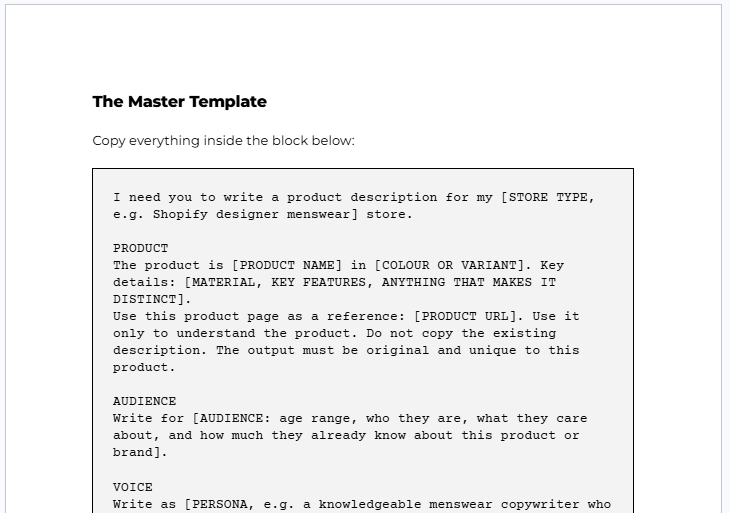
Download the free product description prompt template – File coming soon
Filetype Docx Download Link | Filetype PDF Download Link
Frequently Asked Questions
Will AI always ask me what it needs if my prompt is too vague?
I won’t do it reliably. I find that some models will ask follow-up questions, others will make assumptions and write anyway. Either way, the output suffers. A detailed prompt from the get-go gets you better results than waiting to see what the AI asks for.
Does the same prompt structure work across different AI tools?
Yes. Whether you’re using Claude, ChatGPT, Gemini or any other tool, the same principles apply — product detail, audience, tone, format and close. The models handle prompts slightly differently but the information they need is the same.
Should I give the AI a URL to the product page?
If the model supports web browsing, yes. It gives the AI access to specs, images, and existing copy. Just always include the instruction not to copy the existing description — you want it to use the page as a reference, not a template.
How do I stop AI product descriptions sounding generic?
Two things: give it a specific audience and give it a specific tone. “Write for men aged 35 to 55 who buy quality outerwear” produces different output than “write for adults who like jackets.” The more specific your brief, the more specific the output.
Can I use this approach for bulk product descriptions?
Yes, with one adjustment. Build a master prompt template with all the consistent elements (store type, tone, format, close) and then swap out the product-specific details for each item. You can also ask the AI to write descriptions for several similar products in one session if you give it the full spec for each one.
Has AI made a mess of your store’s content?
If bad prompts have left you with thin copy, duplicate descriptions or content that’s hurting your SEO rather than helping it, I can help you fix it.