
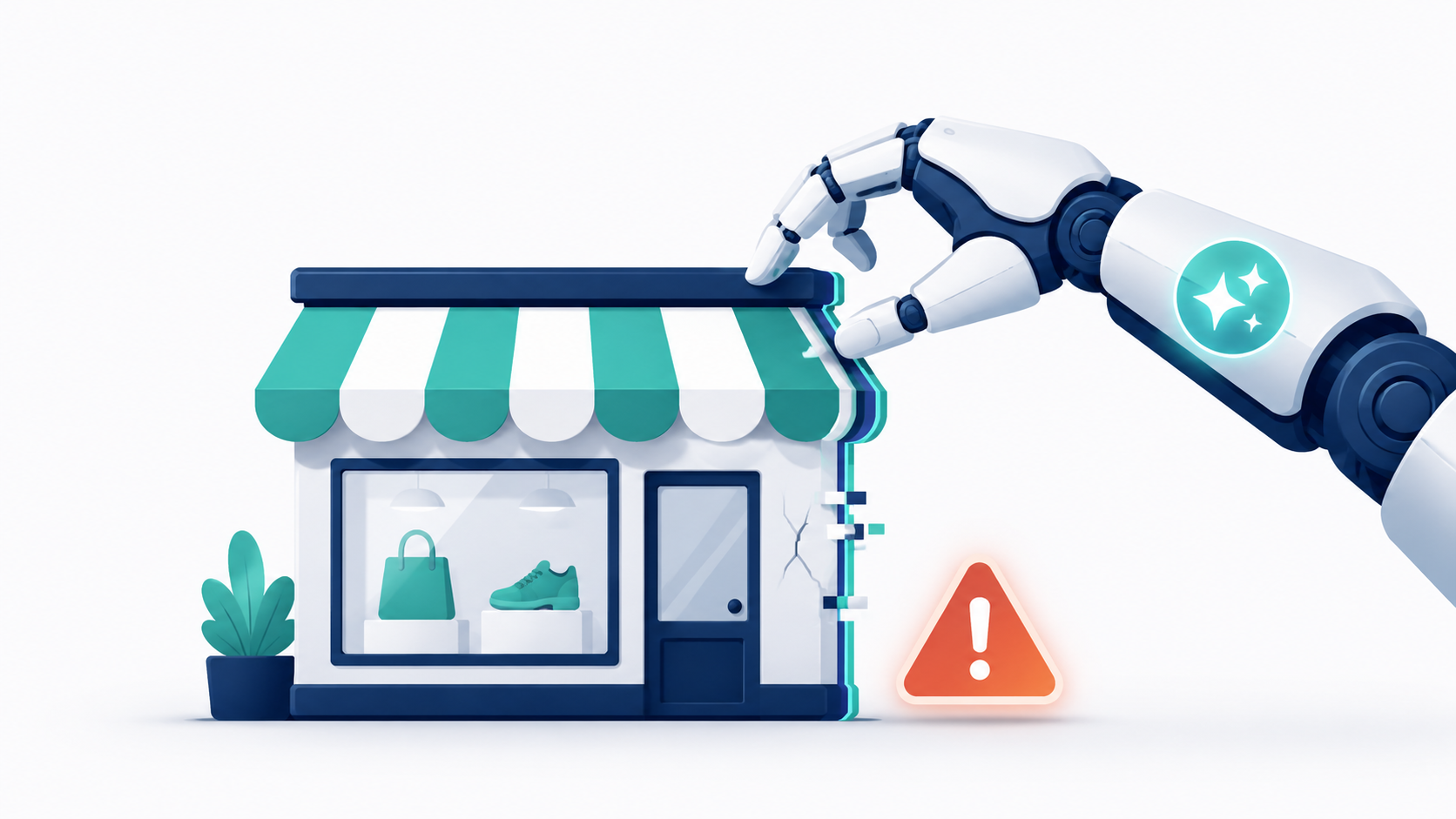
AI SEO Mistakes in Ecommerce
I’ve seen numerous AI SEO mistakes in the past 12 months especially. However, the mistake isn’t using AI for SEO. I use it every day (not just for SEO) and it saves me hours. The mistake is pointing it at a live store without the three things that stop it going wrong:
- A real understanding of SEO
- A full backup
- A small test before you touch the whole catalogue
Get those right and AI can be like having a superpower. Get them wrong and it’s the fastest way I know to undo rankings you spent months earning. Below are the eight mistakes I see most when I’m acting as an SEO consultant, several of which I’ve been called in to unpick after the damage was done.
In This Article
- Letting AI loose before you understand SEO yourself
- Using a vague prompt
- Going all in instead of testing small
- No backup before bulk changes
- Trusting the tool’s green ticks
- Content silos that cannibalise your money pages
- Buying “GEO” from someone who can’t show you results
- Letting AI write at scale with no brand voice and no fact-check
- FAQ
If you want the wider context on how search itself has shifted, this post is one of the spokes off my main guide to ecommerce SEO in the AI age. This one is about the specific ways it goes wrong.
1. Letting AI Loose Before You Understand SEO Yourself
This is the one that causes the other seven. A prompt is only as good as the person writing it, and you can’t write a good prompt for something you don’t understand. If you don’t know what a healthy title looks like or why a category page ranks where it does, you can’t tell whether the AI’s output is helping or quietly wrecking things. Fact.
It starts with intention. Ask yourself, what do you actually want from your SEO? To rank for your own brand name, or for the specific brands you stock, or for the product types people search? Those are different jobs. Ecommerce SEO isn’t one discipline anyway. A content site, a single-brand store and a multi-brand retailer each need a different approach, so “optimise my store” means nothing until you’ve decided which of those you are and what you’re chasing.
The other half of intention is knowing what SEO can’t fix. SEO will only take an ecommerce store so far. If your real blocker is thin product data, a slow site, no reviews or a checkout that leaks, no amount of AI-generated meta descriptions will move the needle. Diagnose the actual blocker first. Then, and only then, start to write the prompt.
2. Using A Vague Prompt
The prompt sets the scene, the intention and the expectation. Any ambiguity in it and you’ve handed the AI room to guess, and it will guess in the most generic, averaged-out way possible. “Optimise my product titles” gets you exactly that: generic, often Americanised, usually with the brand name jammed in three times.
A strong prompt spells out the rules. Compare these two.
A Weak Prompt Example
“Rewrite my product titles and meta descriptions to be better for SEO.”
A Stronger Prompt Example
“Rewrite these product titles in UK English using the format Brand + Product Name + Key Attribute, under 60 characters, no repetition of the brand name in the alt text. Match the search intent of a shopper looking for that specific item. If a product is missing the information you’d need to write a good title, flag it rather than inventing detail.”
The second one can’t drift far, because you’ve closed off the ambiguity. The first one will produce something that looks fine at a glance and reads wrong to anyone who knows the market. This is why the fundamentals matter: you can only write the strong version if you already know what a good title looks like.
3. Going All In Instead Of Testing Small
Do not run an AI change across four thousand products on day one. Take ten. Note where they sit now, apply the change, then watch Search Console for a couple of weeks. If impressions and positions hold or climb, scale it up in stages. If they slide, you’ve lost ten products and learned something cheap, instead of tanking the whole catalogue and finding out three weeks later.
Track your movements properly. There’s rarely a clean undo in ecommerce SEO, so the small, measured test is your undo. Diving in headfirst and discovering months later that you’ve made everything worse is the single most avoidable version of this whole list.
4. Not Doing A Backup Before Bulk Changes
This is a complete disaster if it happens, and it’s the easiest to prevent. Before you let Claude Code, a bulk-edit app or any AI touch your product or category data, export a full backup of your titles, descriptions, meta fields and handles. This doesn’t just stop at using AI – you should do this frequently to ensure you’ve got a recent backup if you’re working on products / collections.
If you overwrite thousands of meta titles / descriptions, then realise the format’s wrong or the tone’s off, then you run into a big problem. Most CMS platforms keep no version history for that data. So once you’ve lost what you had, you are not getting it back. There is no undo button. Without an export, your only route back is re-doing all two thousand by hand, from memory, or from whatever you can scrape out of Google’s cache. The export takes five minutes. Rebuilding by hand takes a week and you’ll never get it fully back to where it was. Back up first, every time, no exceptions. Then read my complete guide to meta titles and descriptions for shopify stores to get a full understanding of what you’re changing and why.
Rule of thumb: if a change touches more than a handful of products at once, it gets a full export before it runs. Treat the backup as part of the job, not an optional extra you’ll do if you remember.
5. Trusting The Tool’s Green Ticks
A tool clearing its own warning lights is not the same as your store being fixed. This is worth repeating because a green dashboard is designed to make you feel safe, and it’s often measuring the wrong thing.
The worst case I’ve seen on a live store was a tool that “fixed” short product titles by injecting new H1s onto the page with JavaScript. You could watch them appear as the page loaded, and the tool’s warnings duly went green. However the actual saved content in the platform never changed. So every page now had two versions, the real one saved in the store and the one being painted on top at load time, and nobody was in control of which one stuck. The big take away from this is that the moment the tool was uninstalled, every “fix” vanished and the store was back to the original, so you were either tied to that SEO tool or you took a hit and lost the data and potentially lost your newly improved rankings. The same tool had filled alt text with “personalize” and “customize” on a UK store selling to UK shoppers, again down to bad prompting and not being clear on the intention.
Check the saved source, not the rendered page, and never trust the tool’s own scoreboard as proof. If a change isn’t saved in your actual product data, theme or CMS, it isn’t a change. It’s a layer of paint that someone else controls.
6. Content Silos That Cannibalise Your Money Pages
This is a subtle one, and it’s where a little knowledge does real damage. You’ll read everywhere that you need content silos and topical authority to get cited by AI, which is true. What you won’t be told is that building them badly on an ecommerce site can outrank the pages you actually sell from. This is a diaster.
Here’s how it happens. Let’s say your category page ranks on page one for “garden lawnmowers”. Then you start publishing blog posts: “top 5 garden lawnmowers”, “what lawnmower should you buy for summer”, “garden lawnmowers reviewed”, “common lawnmower faults and how to fix them”. Your site genuinely becomes a great source of information, and that’s good for authority. However, those blog posts can start outranking your category page and pulling the clicks away from the page that takes the money.
The fix isn’t “don’t write the content”. It’s understanding which query is commercial and which is informational. The shopper searching “garden lawnmowers” wants to buy, so that query belongs to your category page. The one searching “how to fix a lawnmower that won’t start” wants help, so let the blog have that. Then link the blog posts up to the category page rather than letting them compete with it. Get this wrong while an AI churns out posts at volume and you can bury your best-performing page under a pile of your own content. Understanding the difference is exactly the kind of judgement AI can’t supply for you.
7. Buying “GEO” From Someone Who Can’t Show You Results
I get emails most days telling me I need “GEO” to rank in Google, from people who can’t point to a single result they’ve actually produced. Do your due diligence, because this one can cost you real money for nothing.
Google’s own guidance, published in 2026, is blunt about it: optimising for AI search is still SEO, because the AI features run on the same core ranking systems as normal search. Google even named the tactics you don’t need: llms.txt files, chopping your content into chunks, special AI-only schema. So a fair amount of what’s being sold as a separate “GEO package” is the SEO fundamentals with a new label and a markup on top.
Being cited by AI is earned the slow way, not bought in a cold email. This is by incluiding genuinely relevant backlinks from your niche, articles good enough that people actually want to link to them, and being a real authority in your space. If someone’s pitching you a shortcut to that with no proof it’s worked before, the mistake isn’t ignoring them. The mistake is when you start paying them.
8. Letting AI Write At Scale With No Brand Voice And No Fact-Check
Commodity content usually doesn’t get cited anyway. The AI answering the query already has ten versions of the generic article, so a generic one from you adds nothing and earns nothing.
Worse again, AI writing product copy at volume with no human check introduces wrong specs, invented features and the wrong spellings for your market unless your prompts are watertight. On an ecommerce store that means returns when the description doesn’t match the product, Merchant Centre disapprovals when the feed data drifts, and a catalogue that reads like everyone else’s. Use AI to write your draft version and to speed you up, then edit it as the person who actually knows the product and the customer. The editing is where your value sits. Hand that step to the machine as well and you’ve automated away the only bit that made the content yours.
I put together a guide on how to get AI to write better product descriptions which includes a free AI prompt builder template if you would like to use it.
Frequently Asked Questions About Mistakes Using AI in Ecommerce SEO
Is it safe to use AI for ecommerce SEO?
Yes, if you use it as an assistant rather than an autopilot. Understand your own SEO first, take a full backup before any bulk change, test on a small sample and track the results in Search Console before scaling. The tool isn’t the risk. Applying it blindly to a live store is.
Can AI improve my Google rankings on its own?
Not reliably, and not unsupervised. AI can speed up the work, but ranking still depends on judgement it can’t supply: knowing your intention, spotting the non-SEO blockers, and structuring content so it supports your money pages instead of cannibalising them. Point it in the wrong direction and it will get you there faster.
Do I need a separate GEO strategy to be cited by AI?
Google’s own position is that optimising for AI search is still SEO, and it lists tactics you don’t need, including llms.txt files, content chunking and special AI schema. Being cited is earned through real authority: relevant backlinks, link-worthy content and genuine expertise. Be wary of anyone selling “GEO” as a separate product with no results to show for it.
What’s the single biggest AI SEO mistake?
Running a bulk change with no backup. Most CMS platforms have no version history for product titles and meta fields, so if AI overwrites thousands of them and the output is wrong, there’s no undo. A five-minute export before you start is the difference between a quick revert and a week of manual repair.
Will AI-written product descriptions hurt my SEO?
Unedited, at scale, they can. Generic copy doesn’t get cited, and unchecked copy can carry wrong specs or the wrong spelling for your market, which leads to returns and feed disapprovals. Edited by someone who knows the product, AI-assisted descriptions are fine and can save real time. The human edit is the part that matters.
If you read this and think your store might already have a few of these, an outside pair of eyes usually spots them fast, because these mistakes hide behind dashboards that look healthy. I help retailers grow across the whole picture, search, ads, email and the store itself, so the work you put in actually turns into revenue. If you’d like someone who’s undone this sort of thing before to take a look, let’s talk about where your store is trying to get to.
Written by Mark Logan, ecommerce consultant and fractional ecommerce manager. 16+ years in ecommerce, former Head of Ecommerce at Aphrodite Clothing (acquired by Frasers Group), now helping Shopify fashion and independent retailers grow.