

If you are running an ecommerce business on Wix and you are serious about growth, this is worth your full attention. It follows a post I recently put out on Linkedin.
I have spent 15 years working in ecommerce, helping independent retailers scale their online stores across Shopify, Magento and WordPress now in my capacity as a leading UK ecommerce consultant. In that time, one thing has remained consistent, in that the platform you build on either supports your growth or begins to limit it.
Wix has always positioned itself as the accessible entry point for getting a business online quickly. For many, it does that job well. But if your ambitions have grown since you first launched, your platform probably needs to as well.

Recent events around Wix’s financial performance have brought that conversation into sharp focus. If you have been sitting on the fence about a Wix to Shopify migration, what has happened over the last few months should begin to move that conversation up your priority list.
What has actually happened to Wix in 2026?
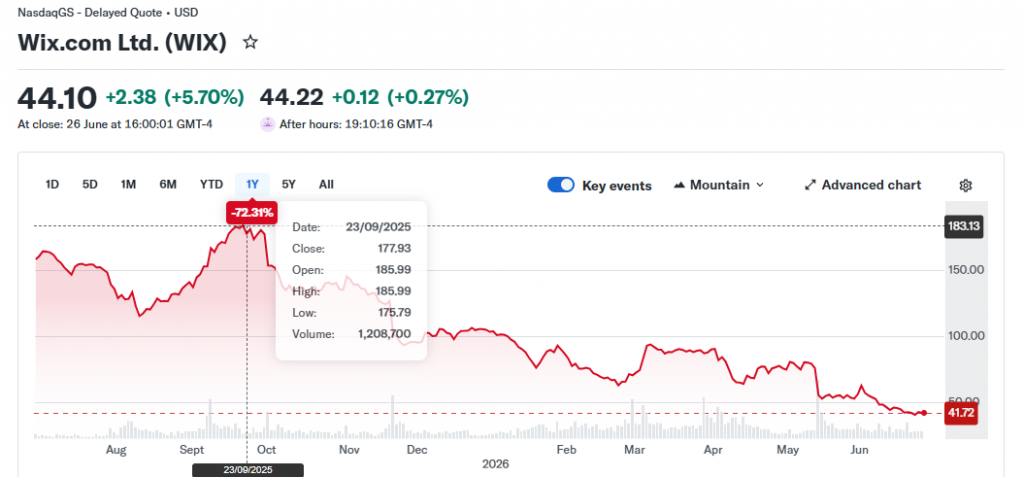
In May 2026, Wix published its Q1 results and missed analyst expectations on both revenue and earnings. The share price dropped around 25% in a single day. That alone would be notable. But it was part of a much bigger picture.
By the end of May, Wix’s share price had fallen nearly 50% since January 2026, down from a market capitalisation of around $20 billion at its 2021 peak to approximately $2 billion. Two weeks after those Q1 results, the company’s CEO announced that Wix would be cutting roughly 20% of its global workforce, around 1,000 people, citing AI disruption and currency pressures as the driving forces behind the decision.
This is not a blip. It is a sustained decline, and the financial markets are reflecting genuine uncertainty about the platform’s future direction.
The screenshot below shows the 1 year YTD performance from highs of 185.99 down to 41.72.
Why does this matter if you sell online?
You might be thinking: I just use Wix to sell products, why does any of this affect me?
Here is the straightforward answer. When a platform’s investor confidence drops significantly, the knock-on effects are predictable. R&D budgets get cut. Feature development slows. Support teams get stretched. The gap between Wix and platforms built specifically for scaling ecommerce businesses gets wider, not narrower.
Wix was designed to help people get online quickly and easily. That was always its strength. But it was never built with the same ecommerce depth as Shopify, which was architected from the ground up for retailers who want to grow.
If your business is moving in the right direction, you will eventually start to feel the ceiling. And the more revenue you are doing when that moment arrives, the more painful and disruptive a migration becomes.
What are the real risks of staying on Wix for ecommerce?
There are a few things worth considering honestly here.
Platform instability affects innovation first. When a company is cutting a fifth of its workforce and managing a 50% share price decline, the focus shifts to survival and restructuring, not building new features for sellers. If you have been waiting for Wix to improve its product filtering, its integration options, or its analytics capabilities, that wait just got longer.
The app ecosystem matters more than people realise. Shopify’s app store has thousands of integrations built specifically for ecommerce, from returns management to subscription billing to feed management for Google Shopping. Wix’s ecosystem is smaller and less mature, and that gap is unlikely to close quickly given the current situation.
Then there is the worst case scenario. It is unlikely, but worth thinking through. If a platform experiences severe financial difficulty, your website sits on their infrastructure. A significant outage, or in an extreme case, a platform shutdown, means your store goes offline. How long could your business sustain that before it started affecting cashflow seriously?
Again, I am not predicting that outcome. But it is a legitimate business risk to factor in when you are making decisions about your tech stack.
Is Wix to Shopify migration the right move?
Not necessarily for everyone, and I would be doing you a disservice if I suggested it was a simple decision.
If you are a very early stage business doing a few thousand pounds a month, the disruption of a migration might not be worth it right now. Wix will likely continue to function adequately for basic selling.
But if you are doing £100,000 or more annually and you are starting to feel the limits of your platform, whether that is through limited filtering options, poor integration with your marketing tools, or restricted customisation, then a Wix to Shopify migration is a conversation worth having sooner rather than later.
Shopify is built for scale. It handles multi-channel selling, complex product catalogues, advanced email integrations, Google Shopping feeds, and affiliate programmes far better than Wix. The businesses I work with on Shopify have far more room to grow without hitting platform-imposed ceilings.
The other thing to bear in mind is that migration only gets harder as your catalogue grows. A store with 200 products, established customer accounts, and years of order history is a more complex migration than a store with 50 products and a shorter trading history. If you are going to make the move, doing it while your catalogue is still manageable saves significant time and cost.
What should you do next?
If you are on Wix and any of this has resonated, the first step is not to panic and the second step is not to do nothing.
Get an independent assessment of your current setup. Understand what platform limitations you are actually hitting, what a migration would involve for your specific store, and what the realistic cost and timeline looks like. That conversation does not have to commit you to anything, but it gives you the information to make a proper decision.
I offer ecommerce audits for retailers who want an honest, impartial view of where their store is now and what their options are. If you are on Wix and thinking about your next platform, I am happy to have that conversation. Get in touch via the contact page and we can take it from there.
Frequently asked questions
Is Wix good enough for ecommerce?
Wix works for small, early-stage stores that need to get online quickly. For businesses doing £100,000 or more annually, or those wanting to scale seriously, it lacks the depth of integration, customisation, and ecommerce-specific features that Shopify provides.
How difficult is a Wix to Shopify migration?
It depends on the size of your store. Products, customer data, and order history all need to be transferred, and your SEO needs careful handling to avoid losing rankings during the move. A well-managed migration minimises disruption, but it is not something to rush or attempt without a clear plan.
Will Wix shut down?
There is no evidence that Wix is at risk of shutting down in the near future. However, its share price has fallen nearly 50% in 2026 and the company has cut 20% of its workforce. Platform instability does not have to mean closure to create real problems for ecommerce businesses that depend on it.
What does Shopify offer that Wix does not?
Shopify’s ecommerce capabilities go considerably further than Wix, including a much larger app ecosystem, more advanced product filtering, better Google Shopping feed management, native subscription and wholesale tools, and a stronger track record with scaling retailers.
How long does a Wix to Shopify migration take?
For a small to medium catalogue, typically two to four weeks when handled properly. Larger stores with complex product data or significant order history will take longer. The SEO transition period is the piece that needs the most careful management.