
AI has fundamentally changed how people search. However it hasn’t changed what makes ecommerce SEO work. I’m going to break down my understanding and experience of how ecommerce SEO has evolved in the AI age.
You’ll have experienced the changes, even if you’ve not took much notice. Google Overviews now sit on top of roughly half of all searches, AI Mode has taken over the search box for over a billion people, and shoppers are asking full questions instead of typing two keywords. Under all of that, the job is the same as it always was. That is, to be crawlable, answer the question your customer actually asked, put that answer on the right page, and be a source worth citing.
What you read below is how I see the shift from an ecommerce operator’s perspective, having run it across live Shopify stores through the whole change, and what I’d actually do about it if this were your store.
In The Article
I’m breaking this down into relevant sections for easy navigation:
- What actually changed in search over the last 18 months
- What hasn’t changed, and why that’s the part that matters
- Ranking isn’t the finish line any more. Being cited is
- Put the right information on the right page
- Are SEO tools still worth paying for in 2026?
- The autopilot trap: how “AI SEO” tools quietly break stores
- So what should an ecommerce owner actually do?
- FAQ
What Actually Changed In Search Over The Last 18 Months
Three major things happened through that 18 month period, and they have compounded through time.
First off, Google put an AI answer on top of the results. AI Overviews launched in the UK in August 2024, and by early 2026 they were appearing on around half of tracked searches, according to BrightEdge data. For a lot of queries, the summary is now the first thing a shopper reads, and plenty of them never scroll past it.
Secondly, the search box itself changed. AI Mode arrived in the UK in mid-2025 and, at Google’s I/O event in May 2026, it stopped being an experiment. It now handles conversational, follow-up-style questions and has passed a billion monthly users. Behind the scenes it uses “query fan-out”, where it breaks your single question into a spread of smaller searches, runs them all, and stitches the answer back together (Reflect Digital has a good plain-English write-up of this). That matters more than it sounds, and I’ll come back to it later in the article.
Third, and because of the first two, how people type has changed. The two-word keyword (“mens gilet”) hasn’t died, but the long question is where the growth is (“is a quilted gilet warm enough for winter” or “what’s the difference between a gilet and a bodywarmer”). People talk to search now because search talks back.
The traffic impact is real, and it’s impacted heavily on retail. In the UK, fashion was one of the fastest-growing sectors for organic visibility before AI search, then flipped to negative traffic growth in the year after it arrived, as per Tank’s analysis of 800 UK companies. If you sell clothing and your organic numbers have gone flat or slipped, you’re not imagining it and you’re not alone.
What Hasn’t Changed, And Why That’s Important Too
Here’s the bit the “everything is different now” proponents skip over. In May 2026, Google published its first proper guidance on optimising for AI search, and once you cut through the noise, the message is quite clear – Keep doing SEO. Its exact position is that optimising for generative AI search is optimising for search, and so it’s still SEO. The AI features run on the same core ranking and quality systems as normal results, so if a page isn’t good enough to rank the old way, it won’t get pulled into an AI answer either. You can read Google’s guide here.
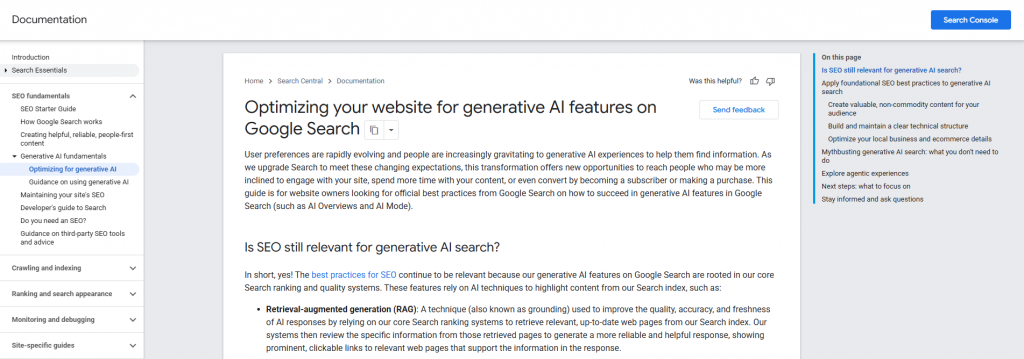
Google went a step further and named things you don’t need to do:
- No llms.txt files
- No chopping your content into “chunks” for the AI
- No special AI-only schema.
I’d look at that as a gift, because a lot of what’s being sold as “AI SEO” right now is exactly those tactics, dressed up and have agencies charging fortunes for. If someone tells you your store will disappear from AI unless you buy the chunking add-on, that’s your first red flag.
None of this has particularly surprised me, and it shouldn’t surprise anyone who’s done this for a while. The fundamentals never changed through the last five algorithm panics such as:
- Clean, crawlable pages
- Content that genuinely answers the question a customer has
- Sensible, non-spammy internal linking
- Good product data
- Fast, unbroken pages.
AI is a new layer sitting on that foundation. It is not a replacement for it. If your foundational SEO is weak, the new layer will not be able to do its job.
The honest version answer is, I don’t know everything about how each engine ranks and retrieves, and anyone who claims they do is guessing with confidence. What I do know is the fundamentals have survived every shift so far, and those are the things worth your money and your time. The layer on top changes but the base doesn’t.
Ranking Isn’t The End Goal Any More. AI Citation Is (Most of The Time)
This is the real shift, and it’s worth sitting with. Ranking number one used to mean you got the click. Now the AI answer can be built from three or four sources, credit them all with a small link, and the shopper gets what they needed without visiting any of you.
Worse for the “just rank first” mindset: ranking and being cited have started to come apart. In mid-2025, the top ten results supplied roughly three-quarters of the sources behind AI Overviews. By early 2026 that had dropped to under 40%, according to Discovered Labs’ analysis. Sitting at position three no longer guarantees you’re the page the answer gets built from. What gets you pulled in is a clean, self-contained passage that answers the exact sub-question, on a page Google already trusts.
So the target moves. It’s no longer only “rank for the head term”. It’s “be the source the answer is assembled from, on the questions that lead to a sale”. Those are related jobs, but they aren’t identical, and treating them as the same thing is where a lot of stores are getting caught out. If you want the full breakdown of how this plays out day to day, I’ve written it up separately: how AI search changes ecommerce SEO in practice.
Put The Right Information On The Right Page
Remember query fan-out, the way AI Mode splits one question into many? That tells you exactly how to structure a store – the information a shopper wants needs to live, in full and in plain language, on the page it belongs to. Not buried three clicks deep, not implied but written down.
This is where good ecommerce SEO and good ecommerce UX have largely become the same job. The pages that keep earning their place are the unglamorous ones:
- Size and fit. A proper size guide, plus fit notes on the product page itself (“runs small, size up”). Fashion queries are full of fit questions, and a fan-out search will go looking for that answer somewhere on your site.
- Delivery and returns. Clear cut-off times, costs, and a returns process explained in words, not just a policy PDF. “Can I return sale items” is a real search, and if your answer isn’t on a page, the AI will happily use a competitor’s.
- FAQs that answer real questions. Not marketing filler. The actual things customer service gets asked twenty times a week. Those questions are your fan-out sub-searches, handed to you for free.
- Product detail. Materials, care, origin, spec. Thin product copy was let’s say survivable when you were fighting for a keyword. It’s fatal when an AI is comparing you to a rival that did it properly.
Group related content so it reads as a coherent set rather than scattered posts, and link it together deliberately. Clustering your content and pointing the internal links where they belong is one of the clearest signals you can send about what you’re actually authoritative on. It helps human shoppers and it helps the machine read you with less guesswork.
One more thing Google’s own guidance leaned on hard – non-commodity content. Generic advice reassembled from what’s already everywhere doesn’t get cited, because the AI already has ten versions of it. The content that earns a mention is built on something only you have:
- Your data
- Your results
- Your first-hand experience of what actually happened
That’s as true for a store’s blog as it is for mine.
Are SEO Tools Still Worth Paying For In 2026?
Yes, SEO tools are still worth using and paying for, but you need to use your judgement and do some research. Here’s how I’d split them.
Google Search Console is a complete non-negotiable and it’s free. It’s still the only place showing you what your site actually does in Google’s eyes, offering real queries, real impressions, real positions, and coverage problems the paid tools only estimate. If you check one thing a week, check GSC. Google has even added an AI-assistant channel in GA4 now, grouping visits that arrive from ChatGPT, Gemini and Claude, so you can finally see whether the answer engines are sending anyone your way rather than just guessing.
The big paid tools still have a place in the market, and they’ve all bolted AI onto their data. Semrush, Ahrefs and the rest now show AI Overview presence and, in their higher tiers, whether you’re being cited in AI answers. That’s genuinely useful for spotting where you’re visible in the old results but invisible in the new ones. Just treat the AI-visibility numbers as a directional signal, not gospel, because everyone’s still working out how to measure this properly. And be sure to check with your plan when signing up because the cheaper plans tend not to include AI citation as a service.
Then there’s the category to be careful with. That is the tools that promise to “do your SEO for you” automatically. Some are fine as assistants. The problem is the ones you switch on and walk away from, and that’s a big enough issue that it gets its own section.
How “AI SEO” Tools Can Quietly Break Stores
I’ve seen this go wrong on a live store, so this isn’t just theoretical.
A tool had been installed on an established site to “fix” its SEO. It reported that it had expanded product titles that were too short and filled in missing fields, and the warnings in its dashboard duly went green. The owner went ahead and installed and ran through the list of missing data, filling it in with what looked like good data. Job done, apparently.
Except it hadn’t changed the store – or at least not what Google was seeing. It was injecting the new H1s onto the page with JavaScript, so you could watch them appear as the page loaded, while the actual saved content in the platform still held the old ones. So there were now two versions of every page: the real one saved in the store, and the one the tool was painting on top at load time. Nobody was in control of which version stuck, and the moment you uninstalled the tool, every “fix” vanished and you were back to the original, none the wiser that nothing had ever really changed.
The same tool had also auto-filled alt text with Americanised wording like “personalize” and “customize” on a UK store selling to UK shoppers. Small thing on its own, wrong signal at scale.
The lesson isn’t “AI tools are bad”. I use these tools every day and they save me hours. The lesson is that a tool clearing its own warning lights is not the same as your store being fixed. If the change isn’t saved in your actual product data, theme or CMS, it isn’t a change, it’s a layer of paint that someone else controls. Test anything like this on a handful of products first, check the saved source and not just the rendered page, and understand what the tool is actually touching before you point it at a live store in the middle of your trading year.
I recently wrote a post about whether you can use AI instead of a developer for Shopify with an example of building a real feature. It is a good segway from this point.
So What Should An Ecommerce Owner Actually Do For SEO Now?
If you strip everything above down to a to-do list, I would suggest this:
- Fix the fundamentals first. Ensure you have crawlable, fast, unbroken pages with real product data. This is 80% of it and always was.
- Get the answers onto the right pages.
- Size
- Fit
- Delivery
- Returns
- FAQs
- (in plain words, where a shopper and a fan-out search will find them)
- Write from experience, not from templates. Non-commodity content is what gets cited and you should be building silos with it. Generic content is what gets ignored.
- Check whether you’re being cited, not just ranked. Ask the answer engines your key buyer questions and see who they credit.
- Use tools as assistants, never as autopilot. GSC weekly, paid tools for direction, and nothing switched on and left to run unsupervised on a live store.
If you’re still weighing up whether “GEO” is a genuinely separate discipline you need to learn, the short answer is that Google itself now files it under SEO.
AI SEO Frequently Asked Questions
Is SEO dead in the AI age?
No, not in the way that many are catastophising. Google’s own May 2026 guidance is explicit that its AI features run on the same ranking and quality systems as normal search, so foundational SEO is still what gets you into AI answers. Search behaviour changed. The fundamentals that make a page worth surfacing did not.
Do I need to do anything special to show up in ChatGPT, Perplexity and Gemini?
Mostly you need to do good ecommerce SEO, then check the results separately. These engines retrieve through their own crawlers and refresh independently, so ranking well in Google doesn’t automatically mean you’re cited in ChatGPT. Ask each one your important buyer questions, see who it credits, and treat any gaps as content to fix.
Will AI Overviews kill my ecommerce traffic?
They will take some zero-click traffic, and UK fashion has already felt it. But cited brands still earn the clicks that do happen, and by a wide margin over uncited ones. The goal shifts from “rank first” to “be the source the answer is built from” on the questions that actually lead to a purchase.
Should I let an AI tool run my store’s SEO automatically?
No. Use them to assist, not to run unsupervised. The risk isn’t the AI, it’s automation applied to a live store by someone who can’t tell whether a change was actually saved or just painted onto the page. Give it clear instructions, understand your own aims first, and check the saved source rather than trusting a green tick in a dashboard. Your prompts are key here.
Does structured data still matter for AI search?
It’s worth keeping for rich results and general clarity, but Google has said there’s no special schema you need to add specifically for its AI features. Don’t let anyone sell you “AI schema” as a must-have. Clean, semantic pages and good content do the heavy lifting.
You can run most of this yourself. If you’d rather not, that’s what I do.
None of the above needs a consultant. A switched-on owner with a bit of time can work through it. But SEO is just one lever, and on its own it rarely moves a store as far as owners hope.
I help independent and fashion retailers grow across the whole picture, search, ads, email and the store itself, so the traffic you earn actually turns into revenue. If you’d like someone who lives in this to look at where your store is trying to get to, let’s talk about that rather than just “SEO”.
Written by Mark Logan, ecommerce consultant and fractional ecommerce manager. 15+ years in ecommerce, former Head of Ecommerce at Aphrodite Clothing (acquired by Frasers Group), now helping Shopify fashion and independent retailers grow.