
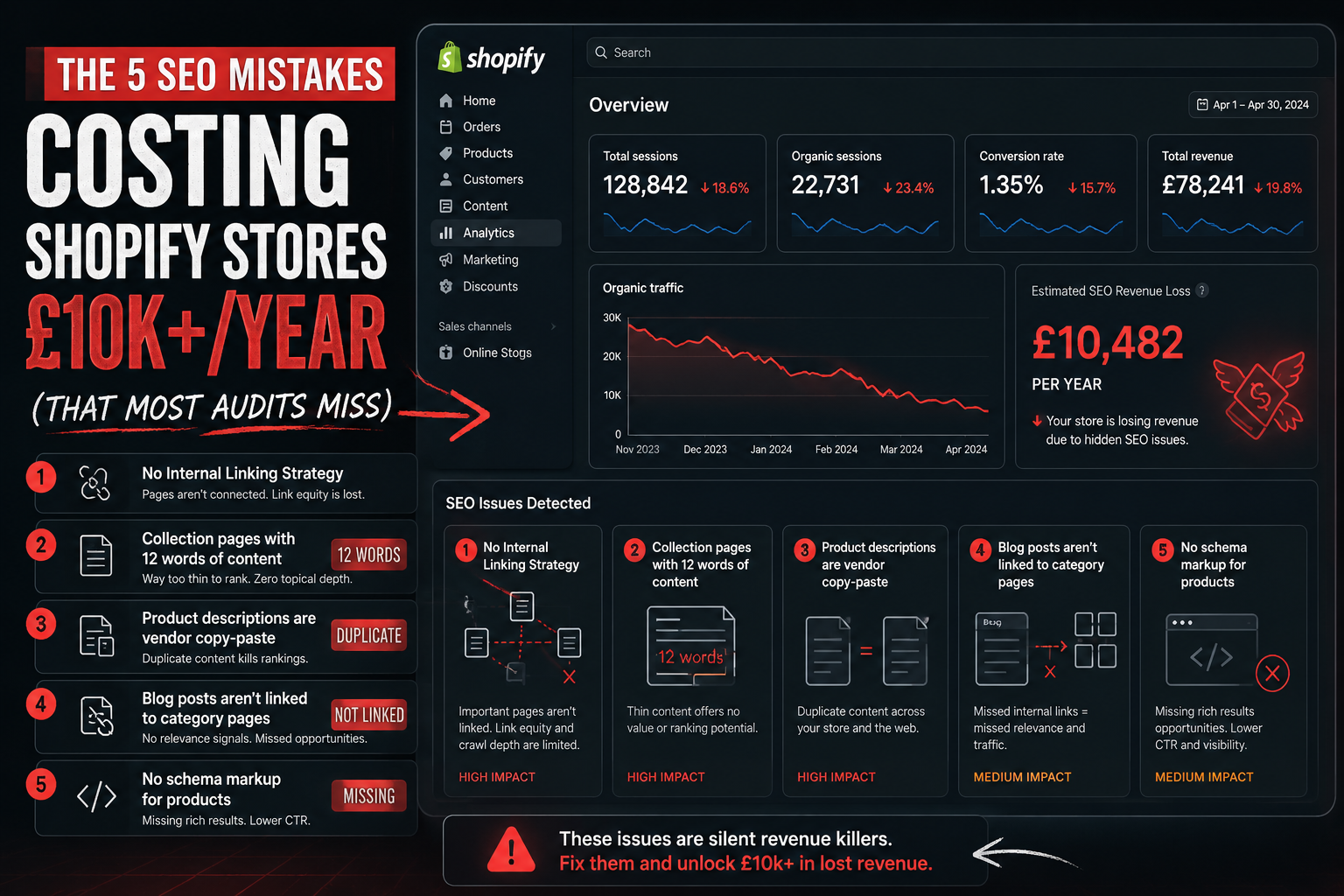
I’ve audited a lot of Shopify stores in the past year as part of my ecommerce consultancy service. I’ve noticed the same five SEO mistakes showing up time and time again. Most ‘SEO agencies’ miss them because they’re running automated tools and not actually looking at the site data.
Screaming Frog will tell you about broken links and SEMrush / AHREFS will flag duplicate titles. However, neither will catch the structural problems that potentially costs you thousands of visits in missed organic visitors.
Here’s some of my findings when I manually review stores to spot SEO / GEO opportunities on an ecommerce site.
Mistake 1: No Internal Linking Strategy
Last month I audited a £1m childrenswear store. They have over 500 products but not a single contextual internal link between product pages. Their individual t-shirts didn’t link back to the t-shirts collections, nor did the t-shirts collection link across to the shorts collection for example. Every product and collection page were islands (commonly known as orphan pages).
Agencies seem to miss this because Screaming Frog doesn’t flag a warning of ‘not enough links,’ only broken ones. Most SEO tools count internal links but don’t take into account whether they make strategic sense. They’ll see you have links in your navigation and footer and move on.
The cost of this is can be more than you’d first realise. Google follows links to discover and understand your site structure. If you’re not guiding it to your most important pages, you’re leaving ranking potential on the table.
Poor crawl efficiency means Google might not even index some of your products (you can see this in Google Search Console). For a store doing £1m annually, that’s could easily be tens of thousands in missed organic traffic depending on your AOV.
The fix isn’t really complicated once you understand what and why Google want you to do this. Plus it’s a benefit to the customer’s journey through your site.
Add three to five contextual links within each product description: “Pairs well with our…” or “Customers also viewed…” or “Complete the look with…”. Every link you add is a vote of relevance Google can follow.
Mistake 2: Collection pages with 12 words of content
The collection pages are completely devoid of any contextual text. The ‘Men’s Jackets’ page has an H1 and a grid of products. That’s it.
Google has nothing to rank as it doesn’t understand anything about the collection. No context about what makes your products different or even any generic information about them. No explanation of fits, fabrics, or styling. Just product thumbnails and a title.
Most agencies should highlight this instantly but you’d be surprised at how many sites are lacking this basic collection information. People optimise meta descriptions and ensure the collection title is descriptive (sometimes). They may check that appropriate headers (H1, H2 etc) are in place. They ensure your URLs are clean. But then they fall short when not bothering to include any actual content on the page for Google to understand what you’re selling.
When you’re up against major department stores turning over tens or hundreds of millions, writing 300-word collection descriptions explaining their range, and writing about seasonal trends / styling tips. And then there’s your site. When Google has to choose which ‘Men’s Jackets’ page to rank, you are going to lose this battle.
I worked with a womenswear store turning over just over a million in annual revenue annually. We added 150-200 useful keywords to their top collection pages. Organic positions and traffic to those pages increased markedly within the first month (granted the keyword difficulty wasn’t as difficult as ranking for designer clothing).
Write 150-250 words. Explain what’s in the collection, who it’s for, why someone should buy from you. Answer the questions people are actually searching for.
Mistake 3: Product descriptions are vendor copy-paste
If your product description starts with ‘This premium quality…’. It is vendor-supplied duplicate content. Google has seen it 500 times. On your supplier’s other clients’ sites, as well as on Amazon and eBay as well as drop-shipping sites where they didn’t bother to write their own descriptions
Agencies are able to run duplicate content checks fairly easily across YOUR site. They make sure you haven’t copied your own product descriptions between pages. However they don’t check if your descriptions match thousands of other sites selling the same product.
Google won’t rank duplicate content. If 30 sites have the exact same copy / paste description for a North Face jacket or a sofa for example, Google picks the most authoritative one. That’s not likely to be you. Your product pages are largely ignored, and you lose money annually in product-level organic traffic you should be getting.
Write your own product, descriptions, stand out from the people copying and pasting from the brand themselves and you’ll see your product pages index. Just write it in your own words, add details about sizing or how it’s beneficial and actually used. Include questions that customers ask you.
Mistake 4: Blog posts aren’t linked to category pages
You wrote 20 blog posts about your chosen sector, trying to establish your authority, just as you’ve been told. The problem is that you didn’t link back to any of your major categories from them – plus an additional tip would be to link to other related blog posts.
Every single one of those posts could be sending link equity to your money pages. Instead, they’re floating out there generating traffic that bounces.
Blogs are often treat as separate entities. Agencies might optimise your blog for traffic, optimise your product pages for conversions, but never connect the two. You’re leaving ranking power on the table.
Every blog post should link to at least one relevant category or product page. “Looking for the perfect pair of selvedge jeans? Check out our Japanese denim collection.” That’s it. Although I would say here that you should factor in how your products go out-of-stock. If the page 404’s, this isn’t a sustainable long term strategy and you’ll be chasing your tail.
Mistake 5: No schema markup for products
Run your product pages through Google’s Rich Results Test. Did it fail (no items found?)
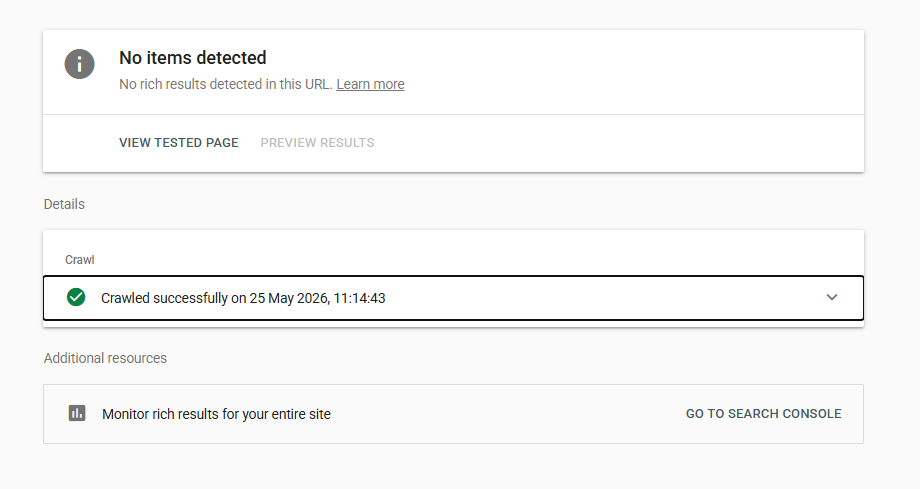
The problem if it fails can be quite significant to your Google visibility.
You’re missing:
- star ratings in search results
- price information
- missing stock availability
- delivery / returns information
Google can show all of this, but only if you tell it how.
The assumption by some is that Shopify handles schema automatically. Sometimes it does.
Often it doesn’t, especially if you’ve customised your theme or you’re using a older template. Most agencies never actually test it.
This can be detrimental causing:
- Lower click-through rates in search results
- When your competitors have star ratings visible and you don’t, they get the click
- Missed perceived authority by people continually seeing you standing out like top retailers do in the SERPS with this additional info.
I audited a jewellery store last year. Their product schema was broken. We fixed it, and their CTR from increased over the next three months. It had the same rankings, but got more clicks and more revenue just from being better looking.
Check your schema with the link above in this section. If it’s broken, fix it. Shopify has apps that’ll do this automatically, or myself or your developer can add it to your theme.
What I do differently
My Shopify audits aren’t automated. I manually check numerous categories and products to get an overall idea of how your SEO is set up. I trace your internal linking. I read your product descriptions. I test your schema myself.
I prioritise by revenue impact. I’ll tell you: “Fix this first, it’s costing you £1k monthly. This other thing can wait six months.”
Some agencies might give you a 50-page PDF with 200 issues ranked by ‘severity’ according to their tool. I don’t believe this helps. You’re overwhelmed, potentially non-technical meaning they carry out the work (at more cost). You don’t know where to start and nothing gets done.
I give you 8-12 prioritised actions with revenue estimates and difficulty ratings. You know exactly what to tackle first. And I give you the choice: DIY instructions for straightforward fixes, or hire me for the complex work.
I’ve been working in ecommerce for over 15 years. I’ve run stores turning over multi-millions in pounds annually. I know the difference between theoretical SEO best practice and what actually moves revenue for SME retailers.
Want to know what’s costing your store?
I conduct SEO audits as well as ecommerce audits. You get a prioritised action plan with revenue impact estimates for every issue I find.
If you’re doing £300k+ annually and your organic traffic has flatlined, there could easily be tens of thousands of pounds in organic traffic just sitting on the table. Check out my Ecommerce SEO service for more details.
Book a free 15-minute call and we’ll talk through whether an audit makes sense for your store. No hard sell. If I don’t think I can help, I’ll tell you.
If you are interested in reading more about my articles: The Shopify Discount URL Trick That’s Hiding In Plain Sight or The Complete Guide To Meta Titles & Descriptions For Shopify sites.
Or alternatively you may be interested in my take on how ecommerce SEO is evolving in the age of AI.